
Asparagus duo
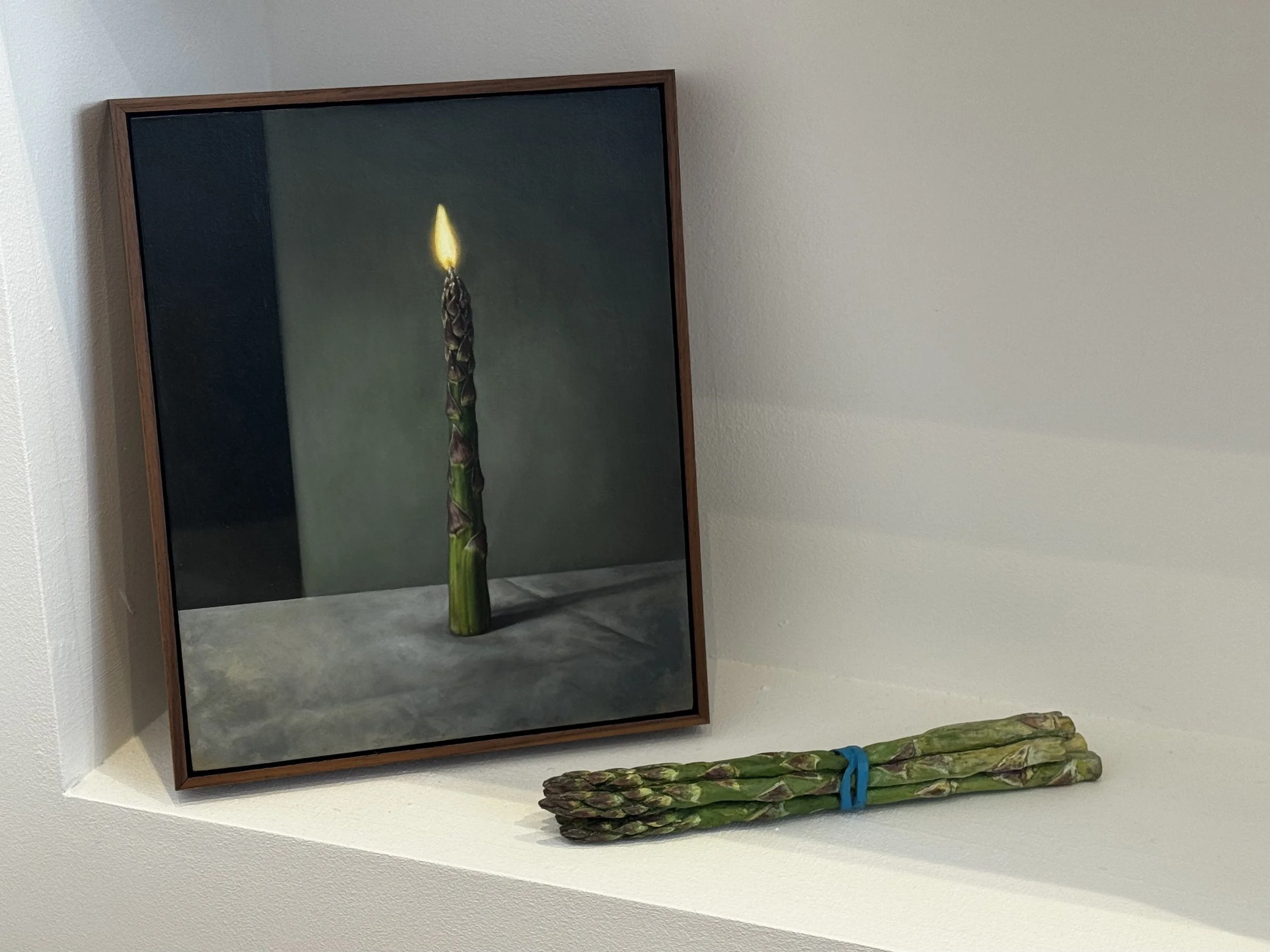
Joel Ely (b.1980)
Burning Spear from Crown, 2023
oil on panel
20 cm × 25 cm
Private collection of the author
Russell Webb (b.1962)
Aspiration (Manet), 2025
Wood, acrylic paint
23 cm × 3 cm x 3 cm
Private collection of the author
I saw the sculpture first. It sat amongst pomegranates and orange rinds and moss covered sticks, all of them lifelike objects carved by artist Russell Webb. At that time my mood was more amusement than acquisition. Still, those little asparagus spears must have lodged themselves deep in my memory banks because less than a month later, like a siren song, I was drawn to Joel Ely’s asparagus painting with such an unexpected attraction that I just had to have it. A few months later Webb’s asparagus teased me again and it didn’t take long for the pair to be complete.
I laughed out loud when I first saw Ely’s painting of an asparagus candle. It was such a somber image, and yet so ridiculously silly. It brought all kinds of questions to mind and made me wonder if there was a shop in London that sold actual candles shaped like an asparagus. What never came to mind was Gerhard Richter.
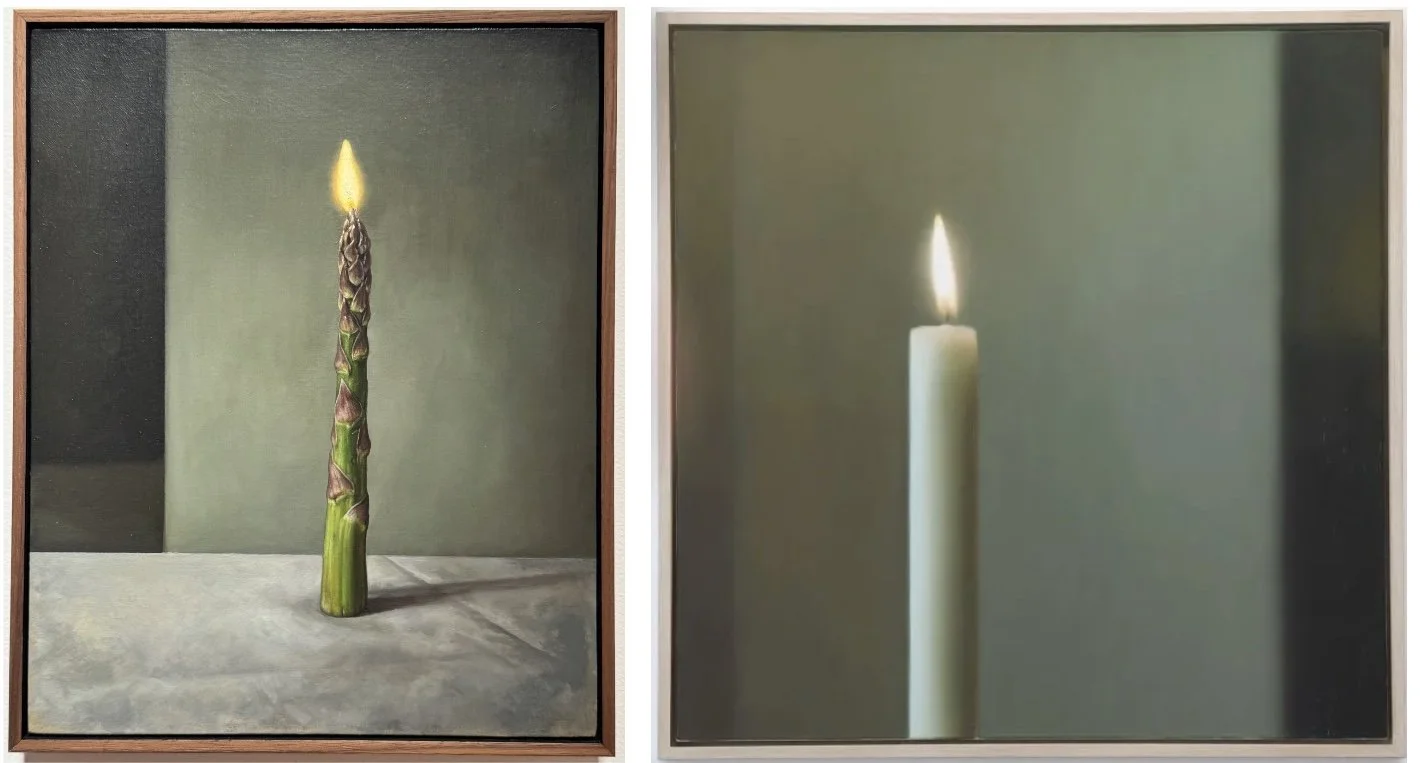
Paintings above not shown to scale.
L: Joel Ely’s Burning Spear from Crown (2023) - 20x25cm
R: Gerhard Richter’s Kerze (1982) - 90x95cm
Ely’s modest little work — only 20 cm wide x 25 cm tall — is in fact a tribute to Gerhard Richter’s series of large scale paintings of candles that he made in the early 1980s. Richter’s works were huge, usually a metre tall and sometimes twice as wide, and they have been captivating art lovers ever since. They’ve been the cover art for albums, written about by art critics and home furnishings moguls, and in 2011 one of them auctioned for £10.5 million. Don’t worry, mum. I paid considerably less for Ely’s tribute.
Like Ely’s painting, Webb’s asparagus tickled my fancy and makes me laugh, at least when I’m not marvelling at just how realistic the damn thing is. A large part of my fascination with Webb’s bundle of asparagus is that it’s been carved out of a single dowel of wood, but that’s what sculptors do. When Michelangelo was asked how he carved David from a single block of marble he replied that he simply removed all the bits that weren’t David. Webb simply removed all the bits that weren’t asparagus, the exact opposite of what I did with a plate of food when I was a child, though I have since learned to appreciate the taste. I still prefer broccoli, though. Here’s a photo I took of Webb’s sculpture next to a real bunch.
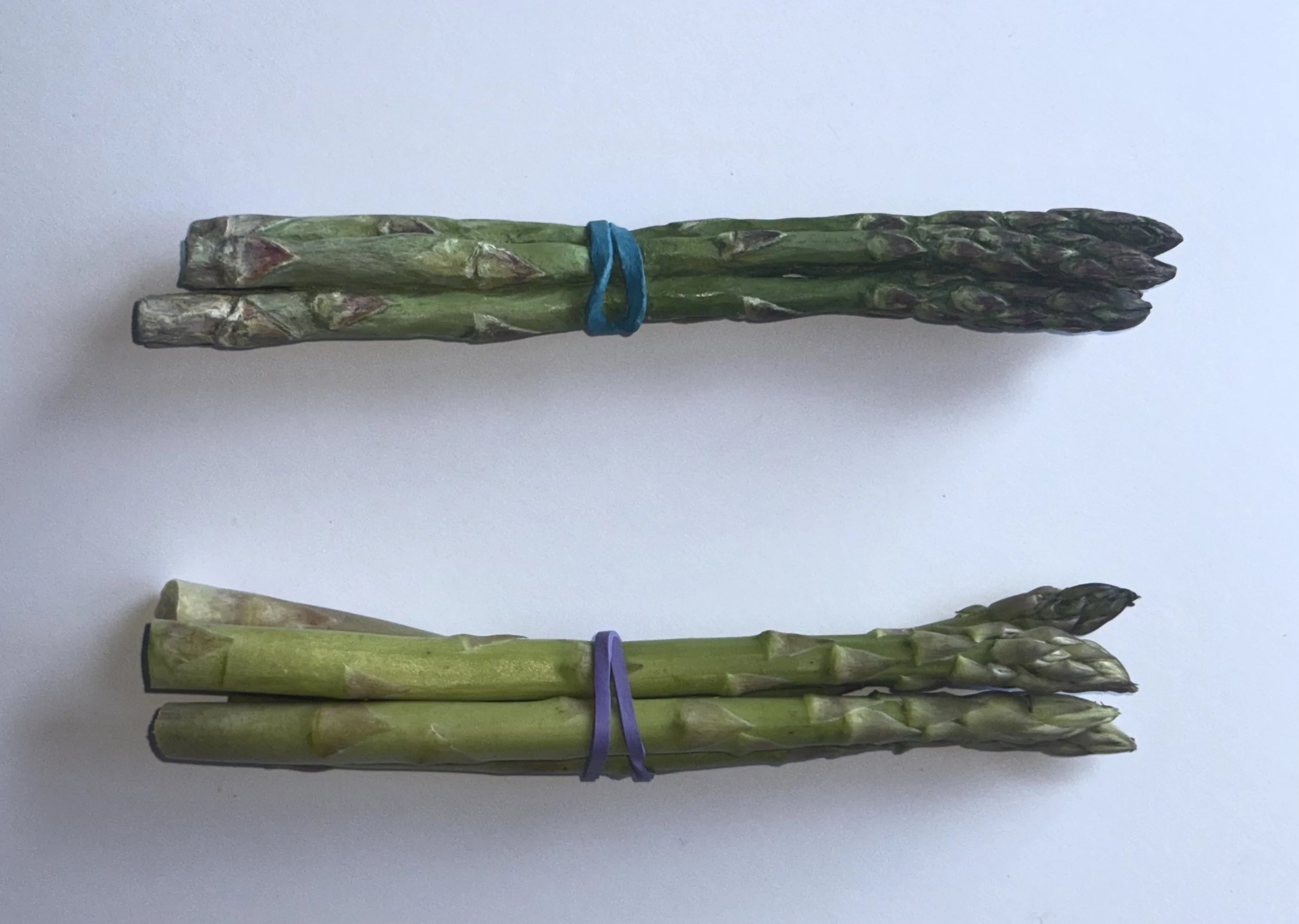
Top: Russell Webb’s Aspiration (Manet)(2025) - 23x3x3cm
Bottom: Waitrose British Bunched Asparagus (2026) - dimensions vary
Webb’s sculpture shares something else with Ely’s candle: it also sent me scurrying down an art history rabbit hole thanks to it’s confounding title: Aspiration (Manet). Why Manet, I wondered? It turns out he was commissioned to paint a bundle of asparagus, and when he was generously overpaid he painted one more sprig that he sent to the collector with an amusing note. Aside from the signature there’s nothing Courtauld-worthy about Manet’s asparagus paintings. In fact, were it not for the title you might not even know what they are, which is definitely not the case with the significantly more true to life depictions by Ely and Webb. They’re so lifelike, in fact, that the French have a name for it.
Long time readers know that I’ve often railed against trompe-l'œil, and not just because I can never remember how to pronounce it. The French term refers to the artistic technique of making highly realistic images of something. It was initially used to describe paintings in the early 1800s, about a quarter century before the invention of photography. The phrase translates as ‘deceive the eye’ and is now commonly applied to sculpture as well. My main issue with the technique is that it is most frequently used for still life which, for the purposes of this article, I will vastly over simplify as ‘pretty pictures of flowers’ because that’s almost always what it’s used for. Or fruit. Artists used to paint way too much fruit.
I’m constantly in awe of the technical skills required to paint or sculpt something photorealistic, but film and television and now digital image creation that can bring to life pretty much anything you can imagine have all conditioned modern audiences to expect something more engaging from our artists. Flowers may be pretty but if I can’t smell them they’re just boring. (Hmm… Maybe I should write a future column about Scratch’n’Sniff artworks?) Audiences and the art world have moved on. If you’re that good with oil and a brush then at least give it a contemporary twist and show me something that resonates with modern culture or how we live today. Or at the very least, make me laugh.
That’s why I recently acquired not one but two (TWO!) asparagus themed trompe-l'œil works. Both made me giggle and still do every time I see them in my study. It’s the kind of art pairing that could take years to discover but because I see hundreds of shows annually this pair came together quite quickly and serendipitously.
That’s why I like it.
When I collect art, it helps to have… a spare, I guess.
Additional reading:
Joel Ely website = joelely.com
Joel Ely Instagram = @joel_ely_art
Russell Webb bio page at James Freeman Gallery
Russell Webb Instagram = @russellwebbstudio
Previously, on Why I Like It:
Apr — Art on the Underground (2000-present), various artists
Mar — Everyone I Have Ever Slept With (1995), Tracey Emin
Feb — Local Village Customs (2021), Thomas Bils
Want more? Here’s a list of the first three dozen articles in this series.