
Everyone I Have Ever Slept With 1963–1995 (1995)
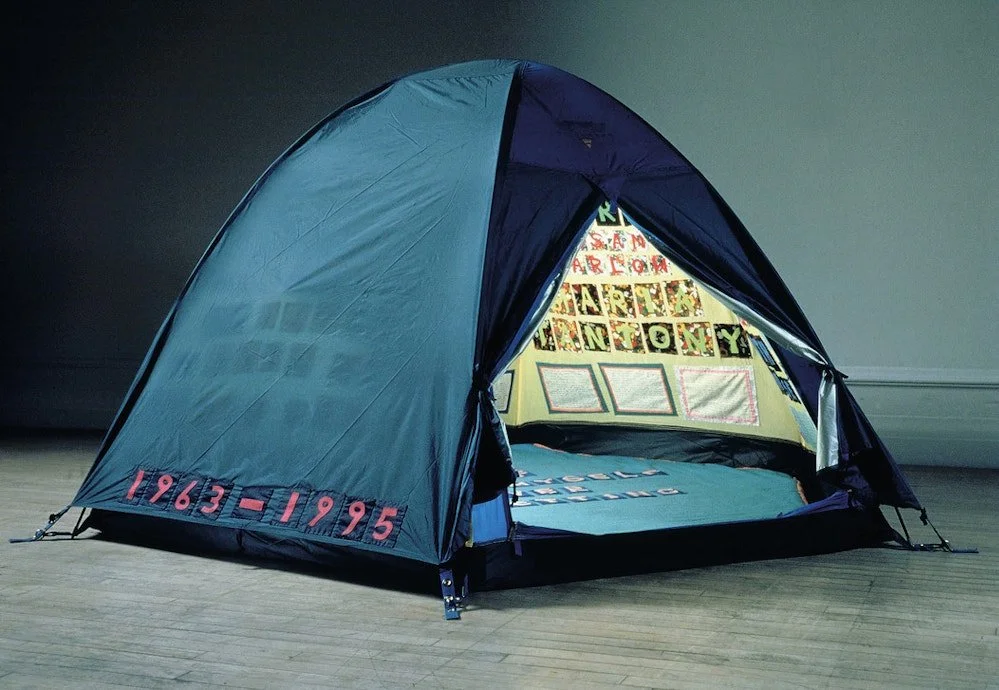
Photo copyright: Stephen White
Tracey Emin (b.1963)
Everyone I Have Ever Slept With 1963–1995 (1995)
appliquéd tent, mattress and light
122 × 245 × 215 cm
Incinerated in Momart warehouse fire, 2004
One of my rules for Why I Like It is that I can only write about works that I have seen in person. And while I have seen Tracey Emin’s tent with my own eyes, and even crawled inside, I’ve had to write this article from memory and research because the tent, officially known as ‘Everyone I Have Ever Slept With 1963–1995’, was burnt and destroyed in a warehouse fire in 2004.
They say timing is everything and I count myself lucky to have experienced the tent when I was in my 20s. Works of art hit you differently depending on the point in your life at which you experience them, and when I saw Emin’s tent I was young and single and relatively inexperienced, and still very immature, in my understanding of sexual relations. So when I read the title — Everyone I Have Ever Slept With 1963–1995 — my reaction at the time was an immediate and male-centric, dismissive chauvinistic assumption about a woman being a slut.
I’m somewhat embarrassed to even admit that today, but I shouldn’t be. My reaction was almost exactly the same as almost any you’ll read. Go on, do a search. Like a perfectly worded stand-up routine Emin’s tent lured everybody in with it’s provocative title, only to serve up a massive gut-punch once you crawled inside to scrutinise the list. Amongst “a lot of names in that tent I’d rather not’ve slept with” you’ll find her Grandmother who held her hand as she napped, her twin brother with whom she shared her mother’s womb, friends, partners, lovers and even references to the two foetuses she aborted.
It has often been slated as a crude and obvious work of art, and let’s be honest: it was. Created during the prime years of the 1990s YBA movement, this attention grabbing piece was the embodiment of the in-your-face / don’t-give-a-f*ck / ladette attitude that Emin was publicly known for at the time. It’s funny, it’s ballsy, and it shoves your sexist attitudes right back down your throat once you take a moment to study it properly. Emin wasn’t specifically targeting insecure young men like myself — the commonly accepted origin story is that she created it in response to her curator boyfriend telling her she needed to create bigger work — but I needed it when I saw it.
Don’t judge a book by it’s cover. “Sleeping together” doesn’t always mean sex. Love has many forms. The messages of that tent weren’t saying anything that hadn’t been said before, but it took Emin’s brash and unflinching honesty about her life to hammer them home into my young brain. I’ve often wondered if I would have been dismissive of the work had I seen it through more mature or experienced eyes. To put it mildly, the critics were unkind and the tabloid press were brutal, especially after it was destroyed in the fire.
Since it’s destruction Emin has repeatedly refused to recreate it. It’s a shame it no longer exists, although to be perfectly frank it’s one of the few works of art that has just as much impact when read about than when seen because like most of Emin’s works the visuals were secondary. In fact, when I look at the archival photos I sourced for this article I don’t even recognise what I remember seeing in the Sensation show, but it wasn’t the shapes of the fabric or colours of the embroidery that I’d committed to memory. The message was her primary intention, and that’s what’s stuck with me ever since I crawled inside.
That’s why I like it.
It’s what on the inside that counts.
Additional reading:
Previously, on Why I Like It:
Feb — Local Village Customs (2021), Thomas Bils
Jan — Patchwork of the Century (1951), Lilian Dring
Dec — 20:50 (1987), Richard Wilson
Want more? Here’s a list of the first three dozen articles in this series.